Understanding airflow measurement helps engineering students connect fluid mechanics theory with practical applications. Concepts such as pressure, velocity, energy conservation and boundary-layer development can initially appear abstract when encountered only through equations. A well-designed laboratory exercise allows students to see how those principles describe the behaviour of a real moving fluid.
One of the most useful instruments for making this connection is the pitot tube. Pitot tubes are relatively simple devices, but the principles behind them provide an excellent introduction to Bernoulli’s principle, airspeed measurement, static pressure, stagnation pressure and practical flow measurement.
At Armfield, we have been developing engineering teaching and research equipment since 1963, with a strong focus on helping students investigate engineering principles experimentally. Our fluid mechanics and aerodynamics equipment enables learners to move beyond theoretical calculations and examine how airflow measurement, pressure measurements and flow velocity behave under controlled conditions.
What Is a Pitot Tube?
A pitot tube is a pressure-measuring device used to help determine the velocity of a moving fluid.
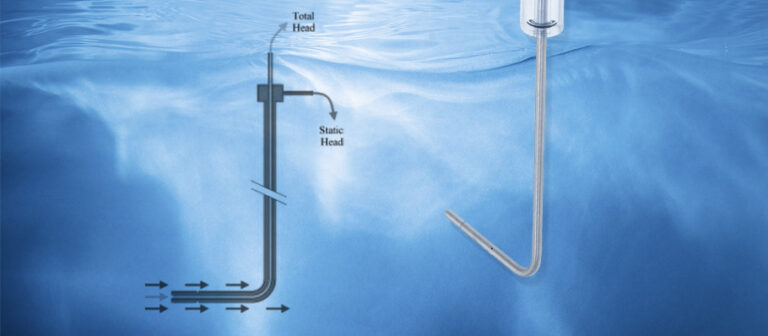
The basic principle is straightforward. When a fluid flows towards the opening of a correctly aligned pitot tube, the fluid at the measurement point is brought approximately to rest. Its kinetic energy is converted into pressure energy, creating what is known as stagnation pressure, or total pressure.
A separate measurement of the static pressure of the surrounding fluid provides the second value required.
The difference between stagnation pressure and static pressure represents dynamic pressure:
Dynamic pressure = stagnation pressure − static pressure
For an incompressible flow under appropriate conditions, Bernoulli’s principle relates dynamic pressure to velocity through:
q = ½ρV²
where:
- q is dynamic pressure;
- ρ is fluid density; and
- V is flow velocity.
Rearranging the relationship gives:
V = √(2q/ρ)
This relationship is one reason pitot tubes are so useful in engineering education. Students can begin with pressure measurements that can be observed experimentally and then use those measurements to calculate flow velocity.
In real applications, engineers must also consider factors such as probe calibration, alignment, fluid properties, turbulence, measurement uncertainty and, at sufficiently high airspeeds, compressibility effects. This is an important part of engineering education: equations provide the foundation, while experiments demonstrate the conditions and assumptions under which those equations can be applied.
Connecting Bernoulli’s Principle with Real Measurements
Bernoulli’s principle is one of the fundamental ideas introduced in fluid mechanics.
In its simplified form, Bernoulli’s equation describes the relationship between pressure, velocity and elevation along a streamline for steady, incompressible, low-viscosity flow.
For many students, however, understanding the equation mathematically is easier than developing an intuitive understanding of what it means physically.
Pitot tube experiments help bridge that gap.
Instead of simply being told that increasing velocity changes the pressure-energy balance, students can take pressure measurements and observe the relationship directly. Static and stagnation pressure can be compared, dynamic pressure determined and the corresponding flow velocity calculated.
This makes a pitot tube particularly valuable when educators are developing lessons around:
- Bernoulli’s principle;
- airflow measurement;
- fluid velocity;
- dynamic pressure;
- static and stagnation pressure;
- pressure measurement;
- aerodynamics;
- boundary layers;
- airspeed measurement; and
- experimental fluid mechanics.
At Armfield, we believe these connections between theory and laboratory demonstrations are an essential part of developing engineering understanding.
Static Pressure, Stagnation Pressure and Dynamic Pressure
To understand pitot tubes properly, students need to distinguish between three important pressure concepts.
Static Pressure
Static pressure is the thermodynamic pressure of the flowing fluid. It is the pressure that would ideally be measured without significantly altering the velocity of the flow.
Static pressure exists whether the fluid is moving or stationary.
Stagnation Pressure
Stagnation pressure is measured when the fluid is decelerated to approximately zero velocity at the measurement point.
A forward-facing pitot opening creates this condition at its tip.
For suitable low-speed incompressible conditions, stagnation pressure contains the contribution from static pressure plus the pressure associated with the fluid’s velocity.
Dynamic Pressure
Dynamic pressure is obtained from the difference between stagnation pressure and static pressure.
That difference can then be related to flow velocity.
Seeing these measurements experimentally can help students understand why a pitot-static arrangement requires both total and static pressure information rather than relying on a single pressure reading.
Armfield’s F1-33 Pitot Tube Demonstrator, for example, is designed to demonstrate the use of a pitot-static tube to measure dynamic head in water flow, investigate the relationship between static, total and dynamic head and determine fluid velocity. The probe can also be traversed across the pipe so students can examine how the velocity profile changes with position.
Why Pitot Tubes Matter in Aviation
One of the best-known practical applications of pitot tubes is aviation.
An aircraft moving through the atmosphere experiences airflow relative to the aircraft. By comparing total pressure obtained from a pitot system with static atmospheric pressure, an airspeed system can determine a pressure difference related to the aircraft’s speed through the surrounding air.
This makes the pitot-static principle fundamental to discussions of airspeed measurement.
For engineering students, aviation provides an immediately recognisable example of how fluid mechanics moves from the laboratory into practical engineering systems.
The same underlying ideas encountered during an airflow measurement experiment — pressure, velocity, density, stagnation conditions and static pressure — become part of a real aerospace measurement problem.
It is important, however, to distinguish between the basic educational relationship and the complete behaviour of an actual aircraft air-data system. At higher speeds and varying atmospheric conditions, factors including air density, compressibility, calibration and instrument corrections become increasingly important.
This progression makes aviation an excellent teaching context: students can start with Bernoulli’s principle and simple pitot tube measurements before moving towards more advanced aerodynamics and compressible-flow concepts.
Using Pitot Tubes to Investigate Velocity Profiles
Pitot tubes can do more than provide a single flow velocity.
If a probe is moved across a flow at known positions, repeated pressure measurements can be used to build a velocity profile.
This has significant educational value.
Fluid travelling through a pipe does not normally move at exactly the same velocity at every point across its diameter. Because of the no-slip condition and interaction with the wall, fluid velocity approaches zero at the surface. Moving away from the wall, velocity increases.
A traversing pitot tube therefore allows students to measure how flow velocity changes across a section and investigate concepts such as:
- boundary-layer development;
- velocity gradients;
- fully developed and developing flow;
- flow downstream of bends;
- wall effects; and
- turbulent flow behaviour.
Armfield’s F6 Air Flow Studies equipment uses a traversing pitot tube for experiments involving velocity profiles, boundary-layer growth and air-jet dispersion. The system allows pressure gradients and airflow behaviour to be investigated experimentally, helping students connect pressure measurements with the structure of a real flow field.
From Pipe Flow to Wind-Tunnel Aerodynamics
The same principles become particularly useful when moving into aerodynamics.
A wind tunnel gives students a controlled environment in which airflow can interact with models, surfaces and aerodynamic shapes. Pitot tubes and other pressure-measuring instruments can then help quantify what is happening inside that flow.
Students might investigate the velocity of the approaching air, measure a boundary layer near a surface or study the wake behind an object.
Armfield wind-tunnel systems support experiments that connect airflow measurement with practical aerodynamics. For example, our C15 range includes a miniature pitot-static tube for airflow investigation, while a flattened pitot tube can be used for measuring air velocity at different distances from a flat plate to compare boundary-layer behaviour.
These types of laboratory demonstrations are particularly valuable because they allow several fluid mechanics topics to be combined within the same learning experience.
Rather than studying Bernoulli’s principle, flow measurement, boundary layers and aerodynamics as completely separate topics, students can see how they interact.
Pitot Tubes in Liquid Flow Measurement
Although pitot tubes are strongly associated with aircraft and airflow measurement, the underlying principle is not restricted to air.
Pitot tubes can also be used with liquids.
Armfield’s fluid mechanics teaching systems include equipment for investigating pitot measurement in water as well as airflow. This gives educators the opportunity to demonstrate that the same fundamental pressure and energy relationships can apply across different fluids and experimental arrangements.
Our C9-MKII system, for example, includes a pitot tube option used as a differential-pressure measuring device. Static and direct pressure measurements allow dynamic pressure to be determined and related to fluid flow. Armfield describes pitot tubes in this context as simple, reliable instruments suitable for a wide variety of environmental conditions.
This breadth is useful when designing a progressive fluid mechanics curriculum.
Students can first learn the pressure relationships in a straightforward hydraulic experiment before applying similar reasoning to airflow measurement and aerodynamics.
Choosing the Right Pitot Tube Teaching Solution
There is no single laboratory configuration that suits every teaching objective.
An introductory fluid mechanics course may require a clear demonstration of static, total and dynamic head. A more advanced course may need students to traverse a probe through a velocity profile. An aerodynamics laboratory might require wind-tunnel measurements close to an aerofoil or flat plate.
That is why at Armfield we provide solutions for a wide range of pitot tube applications, rather than treating the pitot tube as a single-purpose instrument.
Depending on the teaching or research requirement, our equipment can support investigations involving:
- pitot-static measurements;
- liquid flow;
- airflow measurement;
- dynamic pressure;
- flow velocity;
- velocity profiles;
- boundary layers;
- air jets;
- wind tunnels;
- Bernoulli’s principle;
- static and stagnation pressure;
- aerodynamics; and
- laboratory demonstrations.
Whether an institution is introducing basic pressure measurement or developing more advanced aerodynamics experiments, Armfield offers pitot tube solutions that can be integrated into practical engineering education.
Why Laboratory Demonstrations Matter
Engineering education is most effective when students understand not only what an equation says but also why it works and where its limitations lie.
Pitot tube laboratory demonstrations encourage students to collect measurements, process experimental data, calculate flow velocity and compare theoretical expectations with observed behaviour.
That process develops skills that go beyond fluid mechanics itself.
Students learn to consider measurement uncertainty, experimental technique, instrument positioning, repeatability and assumptions in mathematical models.
These are fundamental engineering skills.
An unexpected pressure reading, for example, should not simply be dismissed as an incorrect result. Students can ask whether the pitot tube is properly aligned, whether the flow is sufficiently developed, whether density has been correctly specified or whether turbulence and local disturbances are influencing the measurement.
That investigative process is an important part of becoming an engineer.
Bringing Fluid Mechanics Theory to Life
Understanding airflow measurement helps engineering students connect fluid mechanics theory with practical applications. Pitot tubes provide a particularly accessible way to make that connection because a relatively simple pressure measurement can reveal a great deal about the behaviour of a moving fluid.
From Bernoulli’s principle and flow velocity to static and stagnation pressure, airspeed measurement, boundary layers and aerodynamics, the pitot tube provides a foundation for exploring many important areas of engineering.
At Armfield, our goal is to give educators and students the equipment needed to investigate these principles rather than simply read about them. Our range of fluid mechanics and aerodynamic teaching equipment provides solutions for pitot tube experiments across water flow, airflow studies, wind tunnels, velocity-profile measurements and more.
Explore the Right Pitot Tube Solution for Your Laboratory
If you are planning a new fluid mechanics or aerodynamics laboratory, updating existing teaching equipment or looking for a pitot tube solution for a particular experiment, our team can help you identify the most appropriate Armfield system.
Speak to Armfield about your teaching, research or laboratory requirements and discover a practical solution designed around the experiments you want your students to perform.